
videos +PDF
Course Description
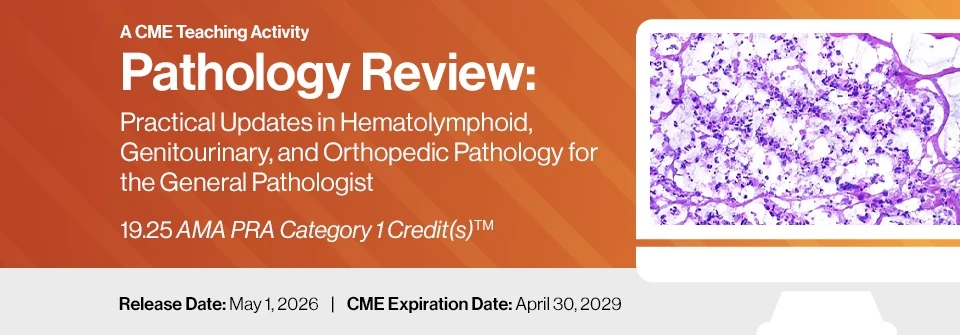
This CME teaching activity provides a comprehensive overview of common diagnostic challenges encountered by practicing pathologists across hematolymphoid, genitourinary, and orthopedic pathology.
The course focuses on key diagnostic features, essential pathological clues, and common pitfalls to help pathologists make accurate diagnoses. Each lecture also highlights the role of ancillary diagnostic techniques, including immunohistochemistry and molecular pathology, with selected case-based discussions.
Target Audience
- Practicing Pathologists
Learning Objectives
By the end of this course, learners will be able to:
- Recognize key issues in arthroplasty specimen evaluation
- Define non-neoplastic and neoplastic synovial diseases
- Improve handling of frozen sections in periprosthetic joint infection
- Identify common musculoskeletal lesions in surgical pathology
- Diagnose benign and malignant hyaline cartilage neoplasms
- Approach giant cell-rich bone neoplasms systematically
- Recognize benign mimickers of prostate cancer
- Identify prostatic lesions with cribriform architecture
- Diagnose urothelial lesions (flat and papillary)
- Classify renal tumors with clear and pink cytoplasm
- Approach CBC abnormalities in adults and children
- Recognize myelodysplasia and myeloid neoplasms
- Understand key features of acute myeloid leukemia
- Diagnose lymphoid disorders in blood and bone marrow
- Identify B-lymphoid and T/NK neoplasms
Course Curriculum
| Sr. No. | Topic | Lecturer |
|---|---|---|
| 1 | Benign Mimickers of Prostate Cancer | Cristina Magi-Galluzzi, MD, PhD |
| 2 | Approach to CBC Abnormalities in Children and Adults | Kathryn Foucar, MD |
| 3 | Common and Uncommon Prostatic Lesions with Cribriform Architecture | Cristina Magi-Galluzzi, MD, PhD |
| 4 | Does My Patient Have Myelodysplasia or Some Other Myeloid Neoplasm? | Kathryn Foucar, MD |
| 5 | Acute Myeloid Leukemia: Journey from Blast Percentages to Next Generation Sequencing | Kathryn Foucar, MD |
| 6 | Flat and Deceptively Bland Urothelial Lesions: Nothing to Be Trifled With! | Cristina Magi-Galluzzi, MD, PhD |
| 7 | Exemplary Myeloid Disorder Cases | Kathryn Foucar, MD |
| 8 | Papillary Urothelial Lesions | Cristina Magi-Galluzzi, MD, PhD |
| 9 | The Pathologist’s Role in the Diagnosis of Periprosthetic Joint Infection | John Reith, MD |
| 10 | Approach to Lymphoid Disorders in Blood and Bone Marrow | Kathryn Foucar, MD |
| 11 | Non-Neoplastic Musculoskeletal Lesions Every General Surgical Pathologist Should Recognize | John Reith, MD |
| 12 | B-Lymphoid Neoplasms in Blood and Bone Marrow | Kathryn Foucar, MD |
| 13 | Renal Tumors with Clear Cytoplasm | Cristina Magi-Galluzzi, MD, PhD |
| 14 | Practical Arthroplasty Pathology | John Reith, MD |
| 15 | Hyaline Cartilage Neoplasms – Radiology to the Rescue! | John Reith, MD |
| 16 | Pink Renal Tumors: How Far Can You Go with Morphology? | Cristina Magi-Galluzzi, MD, PhD |
| 17 | Synovial Pathology | John Reith, MD |
| 18 | Pitfalls & Challenges in GU Pathology | Cristina Magi-Galluzzi, MD, PhD |
| 19 | T/NK-Neoplasms in Blood and Bone Marrow | Kathryn Foucar, MD |
| 20 | Giant Cell-Rich Bone Neoplasms – How to Solve the Mystery | John Reith, MD |
Related products
Uncategorized
$10
Uncategorized
$10
$40
Uncategorized
$10

Uncategorized
$15
Uncategorized
$10